Tuesday, November 22, 2016

Team Composition

Here is how our sub-team' are formed

Tanmayee & Kirara - Deep sea And Tall Mountain/ Storm the Castle
Varun and Pranav - Weather or Not/ Battery Buggy
Saanika and Aarya - Science Jeopardy/ Goldberg's Garage


Competition Rules: Weather or Not

WEATHER OR NOT

Description:

Students will answer questions involving content knowledge and process skills in the area

of meteorology and geology in test format.

Number of Participation: 2

The Competition:

1) Topics of weather and geology in 4th/5th grade textbooks will be covered in addition to

the following advanced topics:

 Natural Phenomena and Disasters (ex- Tornados, Blizzards, etc.)

 Weather Patterns (ex- El Nino)

 Instruments used in Meteorology

 Rock Cycle

 Water Cycle

Scoring:

1) Questions will be assigned point values dependent on question difficulty. Students will

be ranked from highest to lowest score. Ties will be broken with predetermined tiebreaker

questions.

Competition Rules: Deep Sea, Tall Mountain

DEEP SEA, TALL MOUNTAIN

Description:

Students will answer questions involving content knowledge and process skills in the area

of environmental science in test format.

Number of Participation: 2

The Competition:

1) Topics of biology in 4th/5th grade textbooks will be covered in addition to the following

advanced topics:

 Energy Flow (Pyramid)

 Symbiotic Relationships

 Cycles (Water, Carbon, Nitrogen)

 Population growth (Exponential/Logistic growth, Carrying Capacity, know how to

read a population graph)

 Food chains/ Food webs

 Community interactions in general

Scoring:

1) Questions will be assigned point values dependent on question difficulty. Students will

be ranked from highest to lowest score. Ties will be broken with predetermined tiebreaker

questions.


Competition Rules: Battery Buggy

BATTERY BUGGY

Description:

Teams construct a vehicle that uses electrical energy to travel a certain distance.

Number of Participants: 2

Approximate Time: 45 minutes

The Competition:

1) Competitors must design and construct a vehicle prior to competition that will travel

10.0 meters in a straight line.

2) Electrical energy used within the vehicle for any purpose must be stored in

commercially available batteries labeled with their voltage by the manufacturer. The

vehicle must use no more than 4 individual cells (labeled 1.5 volts or less each) or one

single battery pack (labeled 4.8 volts or less). Batteries need not be installed until

immediately prior to the run.

3) Components may be purchased or made by the competitors. (ex.: motors, gears,

chassis, etc.). A list of materials used should be included in the Build Binder.

4) The entire vehicle must fit within a 30 cm. x 30 cm. space when in ready to run

configuration. There is no limit on the height of the vehicle.

5) Competitors must start the vehicle by actuating a switch using a pen, pencil, dowel,

or similar device (provided by Event Officials). The switch must be designed so that the

action of starting it is perpendicular (up or down) to the floor. A horizontally activated

switch is a construction violation and will lead to a penalty.

6) The vehicle must have a fixed, pointed object whose tip is referred to as the fixed

point. The fixed point must be on the front of the vehicle and within 1 cm of the track

surface. All distance measurements will be based on the fixed point.

7) The wheels must be the only parts of the Battery Buggy that contact the floor.

Scoring:

1) Each Run Score is the sum of 2 Components: The Distance Score and the Time

Score. The distance score is the distance from the fixed point to the Final Point in

millimeters. The Time Score is 25 times the official run time measured in seconds.

Teams will be allowed 2 runs, the better score will be used.

2) A maximum of 50 points can be awarded for a neat and well documented Build

Binder.

Competition Rules:Storm the Castle

STORM THE CASTLE

Description:

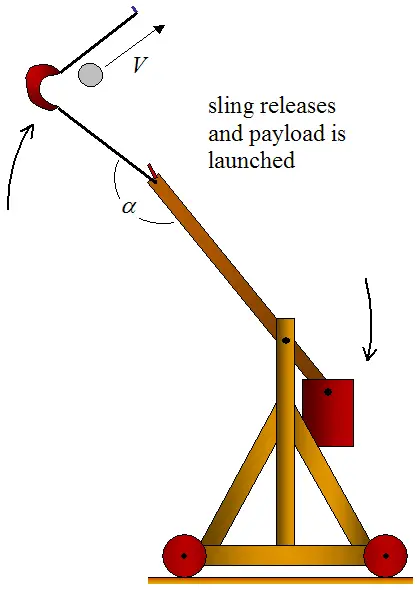
A team of two (2) students will design and construct a trebuchet device to shoot a

beanbag at a target that is placed 6 meters away.

Number of Participants: 2

Approximate Time: 45 minutes

The Competition:

1) Students are to design, construct, and bring to the tournament a trebuchet device

similar to (but not limited to) the sample below. Also, please bring 2 goggles.

2) Catapults are NOT limited to the above design but must fit in an imaginary box with

dimensions 50 cm x 50 cm x 70 cm and made of no construction grade material, with

as few or as many shooting positions as needed to hit a target.

3) Evidence should be collected and presented on a data table which includes the

various designs and ranges produced.

4) The target consists of three to twenty concentric rings with a dot at their center. The

smallest ring is approximately 10cm in diameter with approximately 10 cm between

rings. The center dot is approximately 3 cm in diameter. The center of the target will be

locate between four and ten meters from the starting line.

5) No part of the trebuchet may extend beyond the starting line.

6) Contestants will shoot twice.

7) Bean Bag restrictions: Must be made of cloth or vinyl, no larger than 5in. x 5in. and

no heavier than 30 oz.

Scoring:

1) The score for each shot will be determine by the smallest ring (highest number) any

part of the bean bag is touching or inside of when it comes to rest. The smallest ring is

worth twenty (20) points, with each successively larger ring worth 1 less point.

2) In addition to the 20 points for the smallest ring, an “X” will be awarded for all shots

where any part of the bean bag is touching or within the center dot.

3) The final score will be equal to the sum of the numerical scores for both shots.

4) The greatest number of points determines the winner.

5) Ties will be broken in favor of the team with: first, the most Xs; second, the most

twenties (20), continuing with nineteens (19) through ones (1). Any remaining ties will

be broken in the same manner comparing each shot, 1st through 3rd, in order.

6) A maximum of 50 points can be awarded for the Storm the Castle Build Binder,

which must contain a data table of various variables of your choice (arm length,

counterweight, etc.) and the range produced.

Competition Rules: Goldberg's garage

GOLDBERG’S GARAGE

Description:

Participants will design, build, bring, and test a Rube Goldberg- like Device, which

incorporates Action Transfers and at least 4 of the 6 simple machines to accomplish a

given task in 35 seconds. The task will be identical for each team. Devices will be

constructed prior to the competition.

Number of Participants: 2 team members

Approximate Time: 10 minutes (Set-Up) and 10 minutes (Competition)

The Competition:

1) Teams will complete the following task with their device:

 Raise a flag at the end of 35 seconds

2) The device will be started by the team rolling a toy car. Once the device is started,

the team must step back and wait behind the line designated by the competition

Officials.

3) The device must fit inside an imaginary box 2feet long x 2feet wide x 3feet

high. Please note that this is a large dimension; however make certain that your device

will fit through a single door opening. The device may not use electrical, heat,

chemical, or electromagnetic energy or any other harmful items. The device should be

strictly operated on mechanical energy. All sources of energy and actions must take

place within the imaginary box before, during, and after the device’s operation. The

device will be placed on the ground, not on a table.

4) The task must be accomplished between 30-40 seconds.

5) Points are awarded for each UNIQUE ACTION TRANSFER, 10 points for each Action

Transfer,and a maximum of 50 points for 5 Action Transfers. These do the following:

 Create a unique action.

 Cause a subsequent action that contributes to the completion of the task.

6) Points will also be awarded for incorporating at least 4 of the 6 simple machines. No

extra points will be awarded for using all 6 simple machines.

7) Teams must submit a flow chart to the Event Supervisor as part of the Goldberg’s

Garage Build Binder that describes the sequence in which the Action Transfers will
occur and lists and explains the simple machines that the team has used. Scoring will

be based only on the Action Transfers and Simple Machines contained on the flow

chart. The ONE PAGE flow chart must be easy to follow (well organized, neatly done,

may contain diagrams and brief text).

8) Each device will also be subject to a safety inspection before operation. Uncontrolled

or hazardous non-shielded falling of launched objects, hazardous materials or spills,

hazardous flammable substances, use of electronic, chemical, heat, electromagnetic

sources can lead to disqualification.

Scoring:

The scoring is based on the number of Unique Action Transfers and the use of at least

4 of the 6 Simple Machines. These Action Transfers and Simple Machines must also be

documented in the ONE PAGE flow chart that is required in the Goldberg’s Garage Build

Binder. The term UNIQUE means that a particular Action Transfer can count only the

first time that it is used. Identical Action Transfers of the same type are allowed but not

scored. For example: a rolling ball that knocks down a series of cascading dominoes to

cause the next action is ONE Action Transfer. The rolling ball and the dominoes could

be used again, but would not be scored if used in the same order. Points will be

awarded as follows:

10 points awarded for each successful UNIQUE Action Transfer (A maximum of 5

Action Transfers will be scored. You can use however many you want, but only the first

5 UNIQUE Action Transfers will be scored for a total of 50 points).

20 points awarded for each simple machine used (A maximum of 4 simple

machines will be scored. You can use all 6 simple machines if you like, but only the first

4 UNIQUE simple machines will be scored).

50 points awarded for the successful completion of the task: raising a flag at the

end of 30-40 seconds

50 points awarded for the Goldberg’s Garage Build Binder and the creativity of

the Goldberg’s Garage device.

Penalties:

Subtract 1 point for each second over or under the 35 second requirement to

accomplish the required task.

NOTE: The team will have 2 trials of the device and the better time of the run will be

considered.

Competition Rules: Science Jeopardy

SCIENCE JEOPARDY

Description:

The nature of the game is to choose a category and a level of difficulty from the game

board and view and listen to an answer to a question. The first team to respond with an

appropriate question for the answer will be awarded the specific number of points and

will choose the next topic and level. Please view Jeopardy! episodes to get a better idea

of how this works.

Number of Participants: 2 team members

Approximate Time: Preliminary: 45 min. Final: 60 min.

Competition:

1) A preliminary written test on general science will take place among all the teams (2

members from each team). The 3 highest teams in that written test will be selected to

participate in the final round of Science Jeopardy.

2) In Science Jeopardy, there are 5 categories of answers with values from 100 to 500.

Difficulty of questions should increase with the point values.

3) A category and point value will be chosen from the game board and the answer

revealed. The event supervisor will present the answer on a projector so that all the

teams can see it at the same time and read the answer.

4) The first team to respond must provide the correct question. If it is not correct, the

other teams then have a chance to provide the correct question.

5) After the first two rounds, Final Jeopardy will be played. In this round, there is only

one question and the teams can choose how many points they wish to wager. If they

answer correctly they gain the wagered points, if they answer incorrectly, they will lose

the wagered points.

Scoring:

The team with the highest score wins. Ties will be broken by asking a tiebreaker set of

3 questions. The team that answers more questions correctly faster than the other

team will break the tie.

Competition Rules:Triathlon

TRIATHLON

Description

Three physical skills are interspersed with science questions in an obstacle course that

will be run in relay race style.

Number of Participants: All 6 team members

Approximate Time: Dependent on team

The Competition:

1) Appropriate athletic wear is advised (running shoes, etc.).

2) The physical activity will include such events as: a dash, dribbling a basketball

between cones, a Frisbee accuracy throw, carrying a ball on a spoon, etc.

3) Two students will be placed at each position A, B, C.

4) Written General science questions will be answered by the students at tables A,B,C

where students stop between the physical events. Questions should be answered as

rapidly as possible to avoid a loss of time.

5) Each physical obstacle must be completed correctly before proceeding to the next

station. Students will be given ever-decreasing levels of difficulty in these physical

events so they are able to be successful.

Scoring:

1) The total team time to complete the event as well as the number of correct answers

will be taken into account.

Speed rankings will be converted into points. (Fastest team is team 1 and so

receives 1 point, team 2 gets 2 points, and so on).

The number of missed questions will be added to the team’s points. (If team 1

missed 5 questions, their score is now 6).

The team with the lowest score will be first place and the team with the highest score is

last place.


Sunday, November 20, 2016

Time to get serious!

Good morning all,

I attended coach's seminar yesterday and got lots of useful information to share with all of you.

There are 35 team's participating in the olympiad this year - that's 210 students! You can imagine the olympiad is going to be a tough one this year!

Logistics - Olympiad is on April 15, 2016 at Dougherty Valley High School , all day event from 8AM-6PM. 

There are 7 events at the Olympiad. In our team of 6 members, we will be diving each event into a pair of team members (3 sub-teams, each 2 member). The sub-team will have a responsibility to prepare for 1 theory event and 1 build event. Triathlon is attempted together as one team. Now before you come in tomorrow, please make sure you have an idea of what you'd want to do. Once we form the team, we won't have a chance to change at later point. 


Build Event 

We will discuss about this in our meetup tomorrow

▪ Battery Buggy - Competitors must design and construct a vehicle prior to competition that will travel 10.0 meters in a straight line. 

  • The entire vehicle must fit within a 30 cm. x 30 cm. space when in ready to run configuration. There is no limit on the height of the vehicle.
  • Competitors must start the vehicle by actuating a switch using a pen, pencil, dowel, or similar device (provided by Event Officials).

Scoring: Please refer to the presentation sent via email

See image here for an example:


Goldberg’s Garage - Participants will design, build, bring, and test a Rube Goldberg- like Device, which incorporates Action Transfers and at least 4 of the 6 simple machines to accomplish a given task in 35 seconds.

What is Rube Goldberg device? Look at this


Storm the Castle
A team of two (2) students will design and construct a trebuchet device to shoot a beanbag at a target that is placed within a given range


Theory Event

▪ Deep Sea, Tall Mountain Students will answer questions involving content knowledge and process skills in the area of environmental science in test format.

 Number of Participants: 2 Time : 45 minutes


Topics of biology in 4th/5th grade textbooks will be covered in addition to the following advanced topics:
▪ Energy Flow (Pyramid)
▪ Symbiotic Relationships
▪ Cycles (Water, Carbon, Nitrogen)
▪ Population growth (Exponential/Logistic growth, Carrying Capacity, know how to read a population graph)
▪ Food chains/ Food webs
▪ Community interactions in general

Scoring : Questions will be assigned point values dependent on question difficulty. Students will be ranked from highest to lowest score. Ties will be broken with predetermined tiebreaker questions.

▪ Weather or Not - Students will answer questions involving content knowledge and process skills in the area of meteorology and geology in test format. 

Number of Participants: 2 Time : 45 minutes


Topics of weather and geology in 4th/5th grade textbooks will be covered in addition to the following advanced topics:
▪ Natural Phenomena and Disasters (ex- Tornados, Blizzards, etc.)
▪ Weather Patterns (ex- El Nino)
▪ Instruments used in Meteorology
▪ Rock Cycle
▪ Water Cycle

Scoring : Questions will be assigned point values dependent on question difficulty. Students will be ranked from highest to lowest score. Ties will be broken with predetermined tiebreaker questions.

Science Jeopardy - The nature of the game is to choose a category and a level of difficulty from the game board and view and listen to an answer to a question. The first team to respond with an appropriate question for the answer will be awarded the specific number of points and will choose the next topics and level.

Approximate Time: Prelims – 45 min Final – 60 min

This round has a theory paper and an actual buzzer round (jeopardy)

This round goes a mile wide but only inch deep!


  • A preliminary written test on general science will take place among all the teams (2 members from each team). The 3 highest teams in that written test will be selected to participate in the final round of Science Jeopardy.
  • In Science Jeopardy, there are 5 categories of answers with values from 100 to 500. Difficulty of questions should increase with the point values.
  • A category and point value will be chosen from the game board and the answer revealed. The event supervisor will present the answer on a projector so that all the teams can see it at the same time and read the answer.
  • The first team to respond must provide the correct question. If it is not correct, the other teams then have a chance to provide the correct question.
  • After the first two rounds, Final Jeopardy will be played. In this round, there is only one question and the teams can choose how many points they wish to wager. If they answer correctly they gain the wagered points, if they answer incorrectly, they will lose the wagered points.

Scoring : The team with the highest score wins. Ties will be broken by asking a tiebreaker set of 3 questions. The team that answers more questions correctly faster than the other team will break the tie.


Common for all team members

Triathlon - Three physical skills are interspersed with science questions in an obstacle course that will be run in relay race style. Consists of a Question-Answer challenge and a physical challenge (For ex: Solve these 5 science questions and perform x jump ropes as fast as you can!)


Here is how the logistic going to play on the day on Olympiad.


We're Q - Quail Run. Here is how it plays up. For ex: If you look at the time slot of 9-10AM

The pair team who would take battery buggy, can't take science jeopardy since the two events are at the same time. Similarly the team that is working on Goldberg's garage can't take Deep Sea. Clear? May be not, I'll explain when we meet in person. 


Scoring

  • The total team time to complete the event as well as the number of correct answers will be taken into account.
    • Speed rankings will be converted into points. (Fastest team is team 1 and so receives 1 point, team 2 gets 2 points, and so on).
    • The number of missed questions will be added to the team’s points. (If team 1 missed 5 questions, their score is now 6).
  • The team with the lowest score will be first place and the team with the highest score is last place

Final Scoring

  • The ranks of the team in all events will be added up.
  • The team with the lowest score is first place, and the team with the highest score is last place.


Monday, November 14, 2016

Name the team!

So far I've received two nominations for team names:


  • Science Trooper
  • Team Juno

Learn Science

Good evening families,

Hope you had a great weekend! Here are some of the sites I received that will help our kids to get more science information. You should've already got an invite from me about registering on this site.

https://mysteryscience.com/

http://wonderopolis.org/

Kids also use the Raz kids site at school which I find quite useful. There are various audio books that kids can listen too if they get too tired of reading (which I'm sure they do). They should already have user id/password to get in. 

http://www.kidsa-z.com

Hope this helps.

Coach

PS: Daugherty Valley public library has a great selection of science books. Do check it out. The library is open on weekends too!

Wednesday, November 9, 2016

Earth processes and geology

How is erosion different to weathering?


Well? That is earth process and geology knowledge that you'll need some help for the olympiad.

Here is an answer: Erosion involves removal of solid material by a transporting agent. Weathering is the breakdown of rock into fragments at the Earth’s surface. No movement is involved in weathering.

Want to know more about this process?

Visit following link and catch up on some YouTube videos


Science Jeopardy

Science Jeopardy is a fun game for kids to practice what they've learned as part of regular school curriculum. Of course science olympiad going to make it a little challenging, so in addition to 4th grade science, kids need to learn 5th grade science as well. Here is an example of 4th grade science jeopardy.

https://jeopardylabs.com/play/4th-grade-science-test-review4

http://www.superteachertools.us/jeopardyx/jeopardy-review-game.php?gamefile=600577#.WCP8auErK_M

Here is a fun challenging one 

https://www.jeopardy.rocks/5thgrademcareview/play

A good idea would to compete with kids and promote them to read on the concepts that are not easily understood!

Happy learning!

Coach

Tuesday, November 8, 2016

Concepts to review for next 2 weeks


Among other science concepts let's focus on below concepts for our 11/19 meet up

Refer: http://scioly.org/mediawiki/index.php/Meteorology/Everyday_Weather

  • The Atmosphere

  • Local Wind Patterns/Global Winds
  • Heat Transport

  • Precipitation and Clouds

  • Clouds
  • Optical Phenomena

All of these sections are covered in the link provided above

Some Youtube videos that I'd recommend you review:

Clouds and Cloud Types

Of course there are tons of other youtube videos on each of topic above, feel free to browse them.

Monday, November 7, 2016